Trunk control
Transfer force between upper and lower body without unnecessary rigidity.

RIDER PERFORMANCE · STRONGER IN THE SADDLE
Personal off-horse coaching for ambitious riders who want to develop strength, trunk control, mobility, balance and repeatable capacity—digitally, personally and around their riding schedule.
OFF-HORSE · 12 WEEKS · 1:1 · DIGITAL IN ENGLISH OR GERMAN
The short answer
Rider Performance is Kisaya's personal online coaching route for riders. Training takes place off the horse and complements riding through individually planned strength, trunk control, mobility, balanced physical capacity and conditioning. It does not replace riding instruction, medical care or physiotherapy.
TWO ATHLETES. OFTEN ONLY ONE TRAINING PLAN.
The horse's week, priorities, load and recovery are often planned carefully. Many riders, meanwhile, rely on riding alone to develop everything their own body needs in the saddle.
Yet a rider's body is constantly asked to:
Rider Performance therefore looks beyond how often you ride. It asks which physical qualities support your riding and which can be developed more precisely away from the horse.
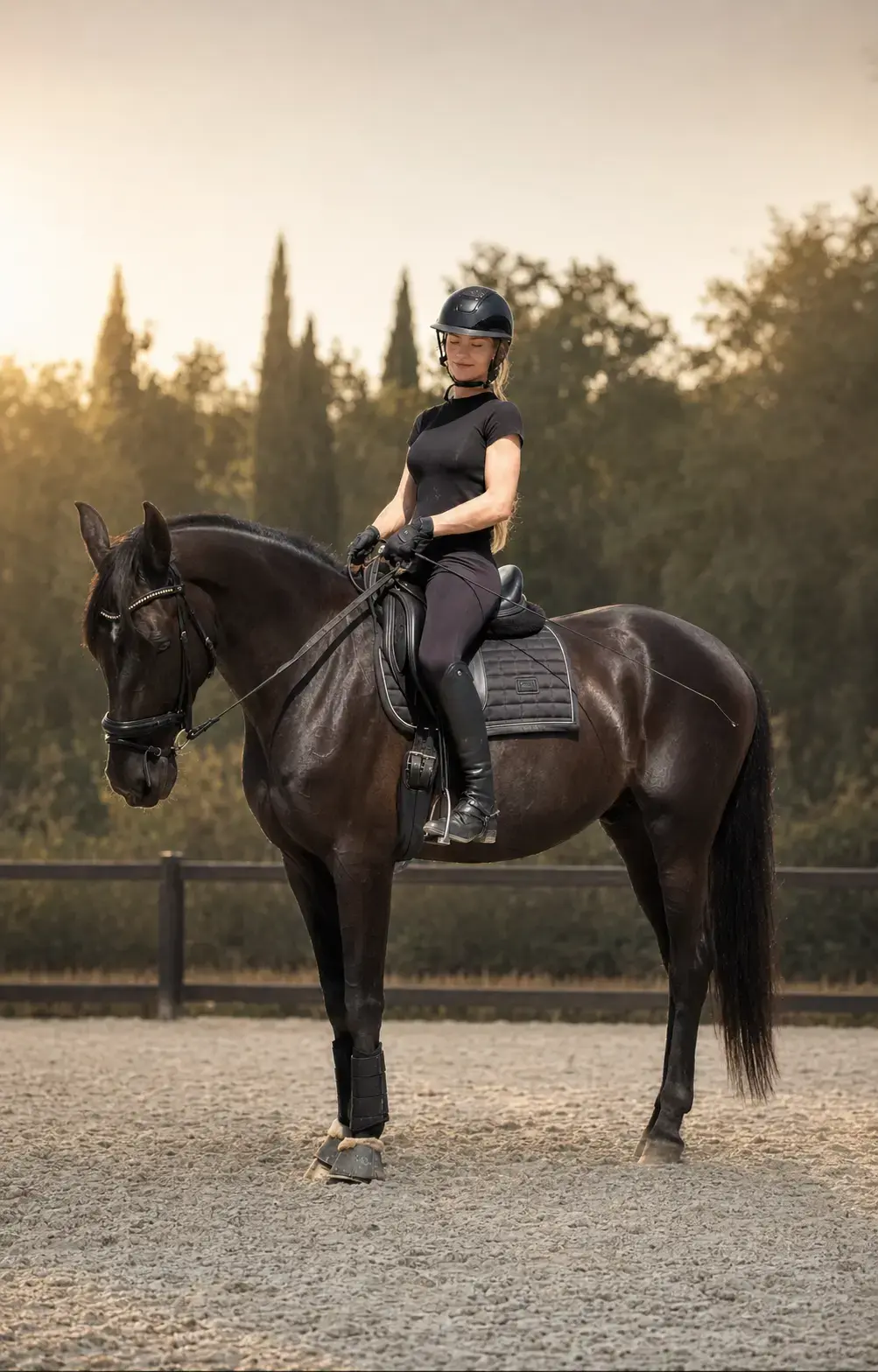
KISAYA KNOWS THE SADDLE BEYOND THEORY
As an ambitious rider, Kisaya knows the particular relationship between stability and mobility from lived experience.
Riders do not need maximum tension everywhere. They need a body that can differentiate: stabilise where control is required, release and follow where movement must be absorbed, and apply strength without becoming coarse.
Kisaya connects that perspective with her experience in strength training, Pilates and yoga. The result is not a riding lesson. It is complementary physical training for the rider.
WHAT THE CURRENT EVIDENCE SUGGESTS
Research on rider-specific conditioning remains smaller than the evidence base in many other sports. Existing studies nevertheless suggest that posture, dynamic trunk control, pelvic control and more balanced loading are relevant to quality in the saddle.
Overall the available evidence remains limited: small samples, varied methods and few studies. It supports cautious interpretation, but no guaranteed outcomes—neither for seat and riding performance nor for the horse's wellbeing.
For Kisaya's coaching, the implication is simple: use off-horse training with purpose, without selling exaggerated performance or horse-welfare claims.
SIX PHYSICAL QUALITIES
The priorities depend on the rider's starting point, riding load, goal and available training time.
Transfer force between upper and lower body without unnecessary rigidity.
Allow movement where the seat needs to follow while retaining orientation and control.
Notice side-to-side differences and develop capacity on both sides without promising perfect symmetry.
Organise the upper body without creating unnecessary tension through shoulders, arms or hands.
Coordinate breath and trunk tension so that stability is not confused with constant holding.
Maintain physical quality more effectively across a session and throughout a training week.
THE OFF-HORSE ASSESSMENT
Coaching does not begin with a random collection of “exercises for riders”.
Within a fitness-oriented scope, Kisaya considers:
Pain, neurological symptoms, acute injury or treatment needs require medical or physiotherapy assessment.
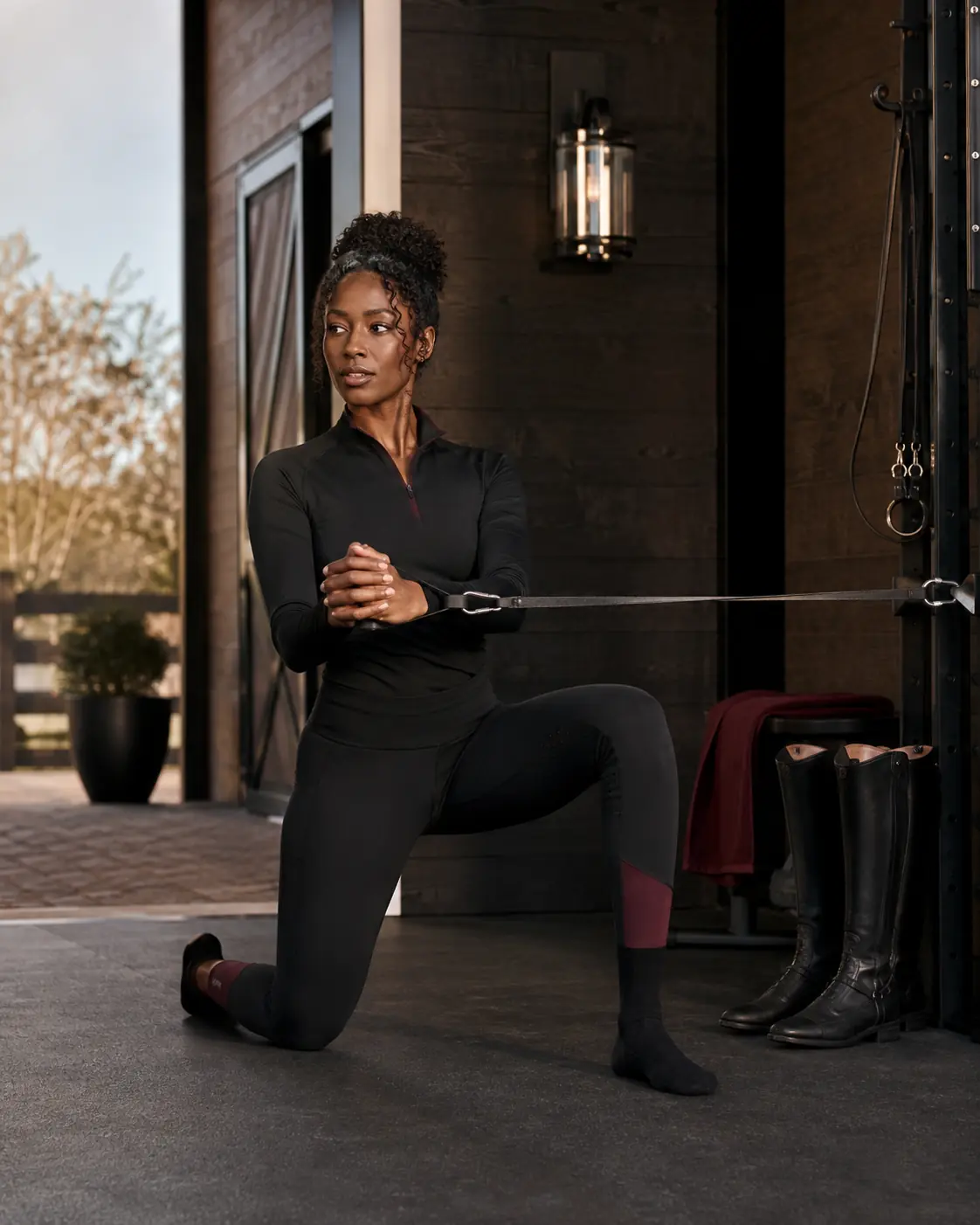
WHAT A COACHING FOCUS MIGHT LOOK LIKE
Lower body, trunk control and unilateral stability with appropriate progression.
Push/pull patterns, posterior chain, shoulder control and robust whole-body coordination.
Targeted mobility, breathing or controlled movement for individually relevant areas.
Sessions are not simply added beside demanding riding days. Volume and weekly placement take account of riding, stable work, recovery and other physical load.
MOBILITY OR STABILITY? THE BETTER QUESTION IS USUALLY: WHERE, WHEN AND HOW MUCH?
A rider may be mobile in one area and poorly controlled in another. One side may feel “tight” even when more stretching is not the decisive answer. Kisaya therefore avoids universal labels such as “weak core” or “not mobile enough”.
Coaching asks which quality is missing or fatiguing for a specific task, and whether strength, mobility, control, coordination or a combination should be trained.
The result is not a label but a clear priority: building the quality that most improves your seat, resilience, and movement control.
WHAT RIDER PERFORMANCE CAN DO
PERSONAL COACHING ROUTE
Rider Performance uses the high-touch structure of KISAYA PRIVATE.
Investment starts at €1,490 for 12 weeks. Your specific coaching setup is defined after the Rider Performance fit check.
Research on rider-specific conditioning is developing but remains limited. Strength, trunk and pelvic control, mobility and considered load management may support the physical prerequisites of riding. Individual results, riding performance, medical effects or effects on the horse are not guaranteed.
FAQ
No. Strength, trunk control, mobility and capacity are relevant in varied equestrian contexts. The actual plan must still account for riding discipline, weekly load, goals and individual needs.
Not necessarily. The plan is built around the goal and available equipment. Some strength goals may benefit from additional equipment, which is discussed during assessment.
The primary focus is off-horse fitness. Riding footage may add context but does not replace riding instruction or detailed in-person technical assessment. The exact scope must be agreed before coaching.
No. Pain and symptoms require medical or physiotherapy assessment. Following appropriate clearance, fitness training may support general strength and capacity but does not treat a diagnosis.
Kisaya considers riding days, intensity, stable work, other exercise and recovery, then places the fitness structure within the total load.
Strength, control, mobility and capacity can support physical prerequisites in the saddle. The individual effect on seat or performance cannot be guaranteed.
Next step
Request a Rider Performance fit check
Personally reviewed · off-horse focus · no riding or medical diagnosis