Trunk control
Resistance to unwanted movement rather than constant bracing.
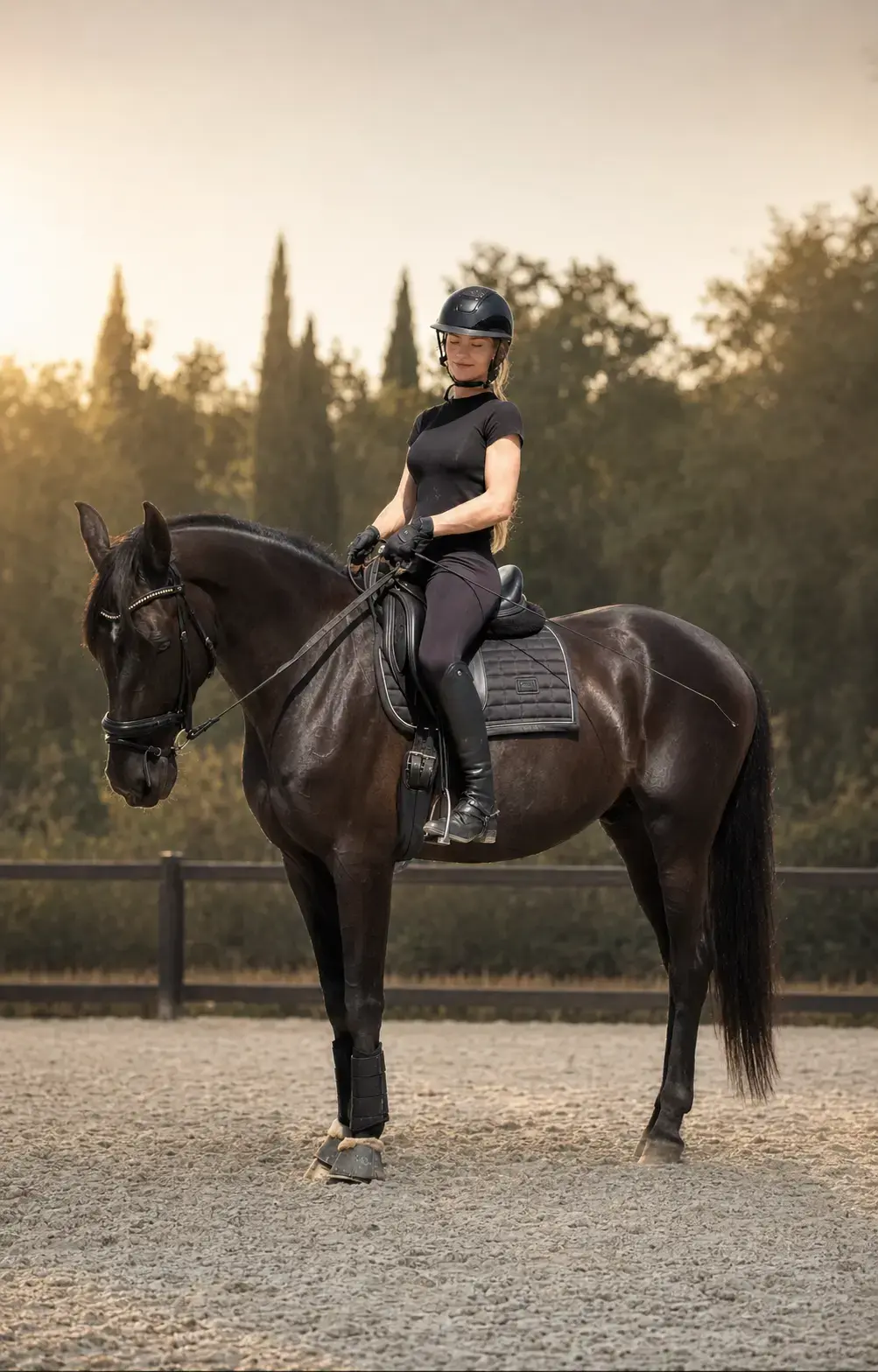
Rider Performance
An independent seat isn't built from more muscle — it's built from targeted control of the trunk, pelvis and breath.
A stable, independent seat depends less on raw strength than on trunk control, pelvic mobility and balanced strength across both sides of the body. Targeted off-horse training can build these qualities deliberately. The boundary: this is fitness training, not riding instruction or diagnosis — saddle fit, horse-side factors and persistent pain belong with the relevant professionals.
Riding places an unusual combination of demands on the body: continuous small balancing adjustments, a quiet, weight-bearing upper body despite movement underneath it, precise and independent control of leg, seat and hand — all sustained over an entire lesson. Unlike many sports, there's no fixed starting position the body returns to; the surface itself keeps moving.
This task calls less for raw strength than for a well-coordinated interplay of trunk, pelvis, legs and breathing. A narrative review of factors influencing rider performance describes exactly this interplay as a key entry point for targeted training off the horse.
A common misconception is that a stable seat comes from constantly tensing the abdominal muscles. In fact, the opposite is closer to true: the ability to resist unwanted movement in the trunk while the rest of the body stays free and responsive. This kind of control — often described in training science as trunk stability in the sense of resistance to motion — can be trained deliberately, but it's distinct from raw abdominal strength.
A study on the influence of riders' physical activity on seat balance found that targeted training of this control capacity measurably improved seat balance, independent of pure abdominal strength training.
Breathing and trunk control are closely linked: the diaphragm is part of the system that stabilises the trunk from the inside. Shallow, held or irregular breathing under tension — a common pattern under nerves or effort in the saddle — weakens this internal stability and makes balancing reactions unnecessarily hurried.
Off-horse training that deliberately integrates breathing into movement builds a foundation that transfers directly to the seat: calmer, deeper breathing even under load, and with it more control in exactly the moments when the horse reacts unexpectedly.
The pelvis transmits the movement of the horse's back up into the rider's upper body. If the pelvic region is too stiff, that movement travels into the lower back or shoulders instead of being absorbed. If it's uncontrolled rather than mobile, precision in the aids is lost.
A study on the relationship between riders' pelvic mobility, balance and equestrian skills found a clear link between good, controlled pelvic mobility and the quality of riding skills. That makes targeted mobility and control work in the pelvic region one of the more effective entry points in off-horse training.
Most people have a dominant side of the body, and riders are no exception. In the saddle, though, such side differences show up noticeably: slightly uneven leg strength or asymmetric trunk control appears in the horse as uneven contact, uneven bend, or a seat that consistently gives slightly on one side.
Off-horse training offers a way to identify and address such asymmetries deliberately — something that's hard to isolate in the saddle itself, where horse and rider are constantly reacting to each other.
A single impressive feat of strength does little for day-to-day riding. What matters is holding the same quality of trunk control, balance and concentration across a full lesson, across several horses, or across a whole competition day. This kind of endurance under fine control is quite different from classic strength training built around a few maximal repetitions.
Training for riders should therefore be built around repeatable quality: moderate intensity, longer sets, deliberate fatigue management — rather than short-term maximal strength.
Certain movement patterns show up in almost every sound off-horse programme for riders, because they address the seat's core demands directly.
Off-horse training doesn't need to take up much space to be effective. Two short, targeted sessions a week, matched to the individual riding schedule and available time, are often enough to produce a noticeable difference in the seat — provided they stay consistently focused on the areas above rather than becoming general fitness work.
Timing within the week matters too: doing trunk and pelvic work on non-riding days, or well ahead of riding, avoids training fatigue undermining riding quality on the same day.
Off-horse training can deliberately build physical qualities — but it can't assess saddle fit, identify horse-side causes of an unsettled seat, or diagnose pain. A study on the prevalence of lower back pain and risk factors among equestrians found that back pain in riding is common and multifactorial — physical fitness is one factor among several, not the sole cause or solution.
Persistent pain, asymmetries that recur despite targeted training, or a seat that doesn't improve despite physical work should be assessed by the appropriate professionals — a physiotherapist with equestrian experience, a doctor, or a saddle-fitting specialist. This article does not replace any of those assessments and does not provide riding instruction.
Practical framework
Resistance to unwanted movement rather than constant bracing.
Controlled mobility that absorbs the movement of the horse's back.
Evening out strength and control differences between the two sides of the body.
Holding quality across the full ride, not just in peak moments.
Frequent questions
General strength helps but isn't specific enough. What matters most is trunk control, pelvic mobility and bilateral balance — areas that call for targeted training.
Two short, targeted sessions a week are often enough, provided they consistently focus on trunk, pelvis and balance.
It can be one factor among several. Persistent back pain should also be assessed professionally, since causes can be varied.
No. It's purely about physical fitness off the horse, not riding technique or lessons.
With persistent pain, recurring asymmetries despite training, or a seat that doesn't improve despite physical work.
The physical qualities discussed here are mirrored against the peer-reviewed literature listed as sources.
No individual performance outcome is promised.
The practical structure comes from Kisaya's coaching and riding practice.
Related articles
Next step
For riders who want to deliberately improve their seat, Kisaya offers training built directly around these qualities.