Clearance and inventory
Get medical clearance; take an honest look at sleep, daily life and how the trunk feels.
Motherhood
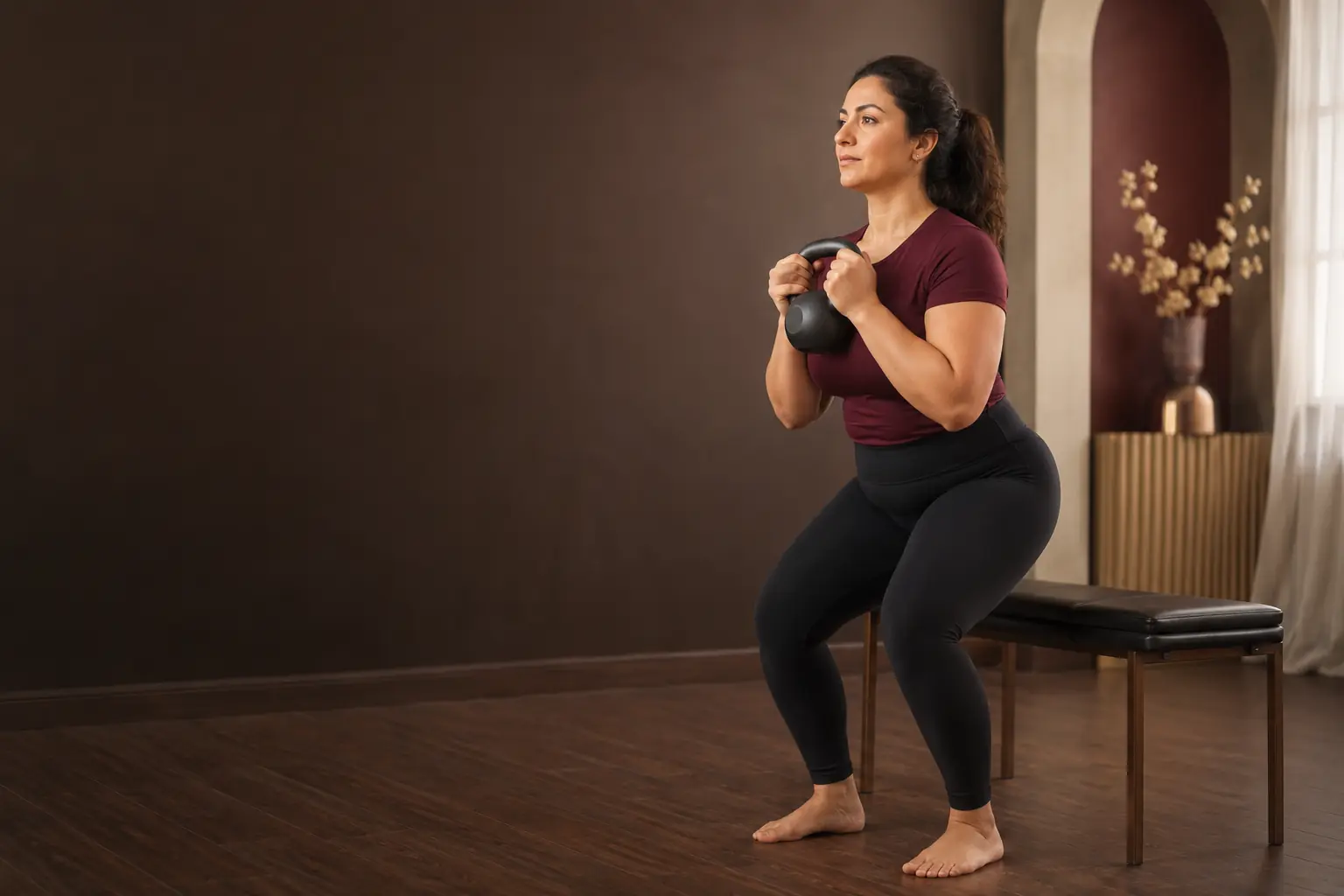
The way back to strength doesn't start with an old body image — it starts with what this body can actually do today.
The way back to strength after birth starts not with speed but with context: healing, sleep, care load and individual clearance. Training then rebuilds capability rather than appearance, step by step, after medical clearance. The boundary is clear: this is coaching support, not medical or physiotherapeutic treatment.
The phrase "getting your old body back" is everywhere — in advertising, in conversation, in the expectations women carry themselves. It's also the wrong starting question for the period after birth. A woman's body after pregnancy and birth cannot be reset to an earlier state like a setting on a device. Tissue, hormones, the pelvic floor, abdominal muscles and the nervous system have changed over nine months, and they keep changing in the months that follow.
Anyone who sets a picture from the past as the goal ends up measuring progress against something that is no longer the starting point. That produces frustration regardless of actual training progress. A more useful question is: what can this body do today, and what should it be able to do in a year? That question can be answered, trained for, and actually reached.
No two births and no two postpartum periods look alike. The type of birth, any complications, how much sleep is realistically available, the number and age of other children, work situation and family support together determine how much capacity is actually there. A training plan that ignores these factors and counts only weeks since birth misses the real starting point.
That's why any sound approach starts with an honest inventory: how is sleep actually going? How does the trunk feel during daily life? Is there pain, a sense of pressure, or uncertainty in certain movements? These answers set the pace — not a generic calendar.
Before targeted strength training begins, individual medical clearance from the treating clinician comes first. This isn't a formality — it's the foundation every later decision rests on. Where relevant, this also includes an assessment by an appropriately qualified professional for the pelvic floor or trunk, for example with diastasis recti, pelvic floor symptoms, or a still-sensitive caesarean scar.
Coaching picks up from the point where this clearance exists. It does not replace it and does not anticipate it. This order protects the woman who wants to train, and it protects the quality of the work together.
Body confidence after birth rarely comes from a look in the mirror. It comes from repeated experience: climbing stairs without hesitation, lifting a child securely, still feeling reasonably capable after a broken night's sleep. These moments are about capability, not aesthetics, and they can be trained deliberately.
Training aimed at capability rather than appearance also changes the inner relationship to the body. Instead of judgment, there's collaboration: the body is experienced as a partner regaining capacity, not a project that needs correcting.
Before weight, speed or volume increase, it's worth working on the fundamentals: functional breathing, coordination between diaphragm and pelvic floor, a stable stance, a clean way of getting up from lying down. These building blocks look unremarkable, but they're the foundation everything heavier is built on.
Skip this phase because it feels slow, and the cost often shows up later — as uncertainty under higher load, a pulling sensation in the trunk, a vague sense of instability. Time invested here isn't a detour; it's the direct route.
Sleep deprivation noticeably changes recovery capacity, concentration and tolerance for load. A training plan that assumes consistently good recovery rarely works in the first months with a baby. A better plan builds in flexibility: shorter sessions on hard days, clearly defined minimum versions for especially exhausted weeks, and permission to move a session without treating that as a setback.
This flexibility isn't a compromise on standards. It's the realistic answer to a life stage where consistency matters more than perfection on any single day.
In a phase where every week looks different, a steadily rising training plan is the wrong yardstick. Progress instead shows up in waves: more in good weeks, less in hard ones, but a clear upward trend in strength and capacity over months.
It helps to track progress across several markers rather than one: how everyday load feels, how stable breathing is under effort, how reliably a planned session can actually happen. That view of progress stays useful even in an unpredictable phase.
Certain signals aren't a sign of insufficient discipline — they're a sign that professional assessment is needed: persistent pain, a sense of heaviness or pressure in the pelvic floor, involuntary leaking, visible doming or separation along the midline of the abdomen under load, or an ongoing sense of instability in the trunk.
In all of these cases, the right next step isn't more training — it's contacting an appropriately qualified professional, such as a pelvic-floor-specialised physiotherapist or the treating doctor. Coaching can meaningfully complement that assessment, but it cannot replace it.
Practical framework
A rough orientation, not a rigid timeline — pace is always set by individual circumstances and medical clearance.
Get medical clearance; take an honest look at sleep, daily life and how the trunk feels.
Build breathing, pelvic-floor-diaphragm coordination and basic movement patterns.
Gradually increase load, volume and complexity, adjusted to sleep and energy.
Establish training as a steady, flexible part of daily life with a baby.
Frequent questions
That depends on the type of birth, any complications and individual healing. The first step is always medical clearance from the treating clinician — the gradual build-up starts after that.
Often yes, but the approach should be coordinated with an appropriately qualified professional. Coaching can support the training build-up afterward, but it doesn't replace that professional assessment.
With flexibility rather than a rigid plan: shorter sessions, defined minimum versions, and evaluating progress by the week rather than by the day.
That's a signal to reduce load and consult an appropriately qualified professional, rather than continuing to train through it.
No. It's about an individual, medically grounded path back to strength and capacity — without a deadline and without promises tied to a particular point in time.
The general orientation in this article is mirrored against official guidance from ACOG, NHS and UCLH.
This article makes no individual recommendation and does not replace personal medical advice.
Related articles
Next step
For women ready to get to know their body again after birth, Kisaya offers support that puts context before speed.